

Key Takeaways
- Fertilizers ensure plant health by providing essential nutrients like nitrogen, phosphorus, and potassium.
- Organic fertilizers improve soil sustainably; inorganic options address immediate nutrient deficiencies.
- Proper application methods—broadcasting, side-dressing, and foliar feeding—maximize fertilizer effectiveness.
- Soil testing, sustainable practices, and tailored fertilization support vibrant growth and reduce waste.
Maintaining the health and productivity of garden plants, particularly edible crops and perennial flowering plants, requires careful attention to their nutrient needs.
Fertilizers play a crucial role in ensuring vibrant blooms and bountiful harvests.
Whether you’re a home gardener nurturing a vegetable garden or a professional managing large garden areas, understanding the types of fertilizers and their applications is essential.
- What Makes Fertilizer Essential for Edible Crops and Perennial Flowers?
- Fertilizer Types for Garden Plants
- Fertilizing Edible Crops
- Fertilizing Perennial Flowering Plants
- Ways to Apply Garden Fertilizer
- Tips for Applying Fertilizer
- Best Practices for Edible Crops and Perennial Flowers
- How Much Garden Fertilizer to Use
- Sustainable Fertilizing Practices
- Common Fertilizing Mistakes to Avoid
- Special Considerations for Midwest Gardens
- Achieve a Healthy Garden With SunCo
What Makes Fertilizer Essential for Edible Crops and Perennial Flowers?
Fertilizer provides the nutrients plants need to thrive.
Essential plant nutrients—nitrogen, phosphorus, and potassium, collectively known as NPK—play distinct roles in growth.
- Nitrogen is crucial for promoting healthy foliage, particularly in leafy vegetables like spinach and lettuce.
- Phosphorus promotes strong roots and enhances flower and fruit production, making it essential for tomatoes, fruit-bearing plants, and perennial flowers.
- Potassium enhances overall plant vigor, helping crops fend off diseases and adapt to environmental challenges.
Adding fertilizers ensures your garden soil has the proper nutrient levels to support healthy growth. Regular soil tests can help determine the exact nutrient needs of your garden.
Fertilizer Types for Garden Plants
Selecting the ideal fertilizer requires understanding the unique requirements of your plants and soil conditions.
Here’s a breakdown of options suitable for edible crops and perennial flowers:
Organic Fertilizers
Natural fertilizers, including options like compost, animal manure, and bone meal, are sourced from organic materials and contribute to enriching the soil sustainably.
These fertilizers release nutrients slowly, improving the garden soil’s structure and increasing organic matter over time.
Examples of organic fertilizers:
Compost
- Nutrient Content: Varies but generally contains small amounts of nitrogen, phosphorus, and potassium.
- Best for: Improving garden soil structure and fertility.
Manure
- Nutrient Content: Typically contains 1–2% nitrogen, 0.5–1% phosphorus, and 0.5–1% potassium.
- Best for: Pre-planting soil enrichment in vegetable gardens.
Bone Meal
- Nutrient Content: High in phosphorus (10–12%) and calcium.
- Best for: Promoting root and flower growth in perennial flowering plants.
Fish Emulsion
- Nutrient Content: Approximately 5% nitrogen, 1% phosphorus, and 1% potassium.
- Best for: Quick nutrient boosts for edible crops and flowers.
Inorganic Fertilizers
Inorganic fertilizers, also known as synthetic fertilizers, are manufactured to provide nutrients in precise amounts.
They are fast-acting, making them ideal for dealing with immediate nutrient deficiencies.
However, excessive use of synthetic fertilizers can cause harm to garden plants and can pollute waterways.
- Best for: Quick nutrient boosts during critical growth stages.
Examples of inorganic fertilizers:
Granular Fertilizers
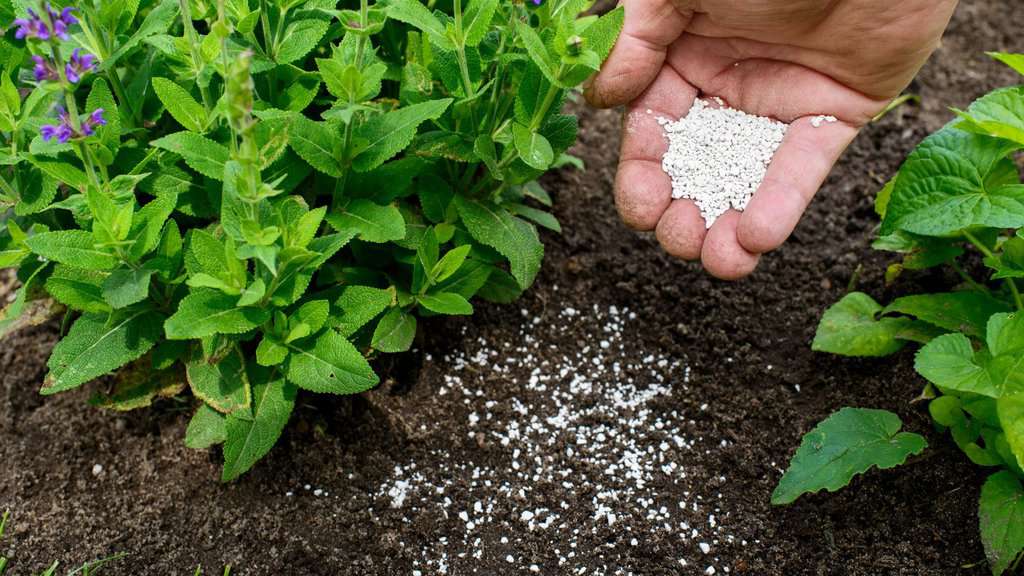
Granular fertilizers are applied to the soil. They can be a slow-release or a quick-release one. They are perfect for side-dressing or pre-planting applications.
- Nutrient Content: Varies (e.g., 10-10-10 or 20-10-5 for NPK).
- Best for: Lawns, vegetable gardens, and shrubs requiring sustained nutrition.
Liquid Fertilizers
Liquid fertilizers are diluted in water and then applied to the soil or foliage. These fertilizers are ideal for applying during the growing season when plants need immediate nutrients.
- Nutrient Content: Typically 15-30-15 for NPK.
- Best for: Foliar feeding, edible crops, and container-grown plants during the growing season.
Slow-Release Fertilizers
- Nutrient Content: Depends on formulation (e.g., nitrogen released over several months).
- Best for: Perennial flowering plants and long-term soil feeding.
Synthetic Fertilizers for Specific Needs
- High nitrogen fertilizers (e.g., 34-0-0 for NPK) for lush, leafy greens.
- Balanced fertilizers (e.g., 10-10-10 for NPK) for general use in vegetable and flower gardens.
Fertilizing Edible Crops
Edible crops, such as vegetable plants, require a balanced nutrient supply throughout their growth cycle.
Leafy Greens
Leafy greens, such as lettuce and spinach, flourish on nitrogen-rich fertilizers.
Too much nitrogen, however, can cause excessive leaf growth at the expense of taste and texture. Side dressing with a dry fertilizer is an effective method to maintain balanced growth.
Tomatoes and Sweet Potatoes
Tomatoes need fertilizers high in phosphorus and potassium for robust roots and fruit production. Use bone meal or a balanced fertilizer to ensure steady growth.
Sweet potatoes, on the other hand, benefit from organic matter-rich soils enriched with compost or manure.
Vegetable Gardens
Vegetable gardens benefit from applying fertilizers before planting and side dressing during the growing season.
Organic fertilizers, such as manure and compost, are ideal for improving soil fertility and structure.
Fertilizing Perennial Flowering Plants
Perennial flowers rely on a steady nutrient supply to produce vibrant blooms year after year.
- Phosphorus-rich fertilizers encourage flower production.
- Organic fertilizers improve soil health, supporting long-term growth.
- Adding organic matter helps retain nutrients and water in sandy soils.
- Granular fertilizers are a great option for slow-release feeding, while a liquid fertilizer can be used to give plants an extra boost during their blooming season.
Ways to Apply Garden Fertilizer
You can apply garden fertilizer in five ways.
Broadcasting
Broadcasting is spreading dry fertilizers evenly across a garden area before planting or over an established bed.
This method is suitable for vegetable gardens and large perennial beds where uniform nutrient distribution is essential.
- Use: Granular fertilizers, compost, or manure.
- Best for: Preparing garden soil before planting.
Side Dressing
Side dressing involves applying fertilizer in a narrow band beside the rows of plants during their growing season.
This technique provides a steady supply of nutrients, especially for crops like tomatoes, sweet corn, and leafy greens.
- Use: Dry fertilizers, granular fertilizers, or compost.
- Best for: Vegetables like peppers, carrots, and cucumbers.
Fertilizer Spikes or Tablets
These are compressed forms of fertilizers placed directly in the soil near garden plants. They release nutrients slowly, making them ideal for perennials, shrubs, and trees.
- Use: Slow-release fertilizers.
- Best for: Perennial flowering plants and trees.
Foliar Feeding
Foliar feeding involves spraying liquid fertilizers directly onto plant leaves. It allows nutrients to be absorbed quickly, providing immediate benefits during critical growth stages.
- Use: Liquid fertilizers.
- Best for: Nutrient deficiencies or quick boosts for vegetable and flowering plants.
Incorporating Fertilizer into Soil
For new garden beds, incorporating organic matter such as manure and compost into the soil before planting ensures nutrients are readily available to seedlings.
- Use: Organic matter or granular fertilizers.
- Best for: Vegetable garden preparation.
Tips for Applying Fertilizer
Before you go ahead with fertilizing, we’d like to share some tips with you.
Conduct Soil Tests
A soil test can help you find out the nutrient levels in your garden soil, ensuring that fertilizers are applied at an acceptable level. This prevents issues like too much fertilizer or nutrient imbalances.
Use Slow-Release Fertilizers
Slow-release fertilizers ensure nutrients are delivered gradually, reducing the risk of burning plants or over-fertilizing.
Incorporate Organic Matter
Adding organic matter improves soil fertility and structure. This approach is especially advantageous for growing vegetables and maintaining vibrant flower beds.
Avoid Over-Fertilizing
Applying too much nitrogen or other nutrients can harm plants, causing weak roots or excessive foliage growth instead of flowers and fruits.
Best Practices for Edible Crops and Perennial Flowers
In caring for your garden plants, you’ll want to know suitable practices that get the best results.
For Edible Crops
- Early spring: Apply an organic fertilizer like compost before planting seeds or seedlings.
- Growing season: Use liquid fertilizers to boost growth and maintain soil fertility. For crops like leafy greens, side dressing with nitrogen-rich fertilizers ensures a steady nutrient supply.
- Late summer: Prepare the soil for the next growing season by adding organic matter.
For Perennial Flowers
- Fertilize during active growth periods using phosphorus-rich fertilizers to enhance blooms.
- Incorporate bone meal or fish emulsion for additional plant nutrients.
- Irrigate your plants after applying fertilizer to ensure nutrients seep deep into the soil.
How Much Garden Fertilizer to Use
Knowing the right amount of garden fertilizer means your plants can grow healthily, preventing over-fertilizing or under-fertilizing from happening.
General Guidelines
The amount of garden fertilizer needed depends on the soil’s nutrient levels, the type of plants being grown, and the fertilizer’s nutrient content.
A soil test is the best way to determine the specific needs of your garden soil.
Vegetable Gardens
- Before planting: Apply 2–4 pounds of a well-balanced fertilizer for every 100 square feet of gardening space. Incorporate it into the top 6–8 soil inches.
- During growth: Apply side dressing with 1–2 pounds of granular fertilizer per 100 feet of row.
Perennial Flowering Plants
- Apply 1–2 pounds of phosphorus-rich fertilizer (such as bone meal) per 100 square feet during planting.
- Use a slow-release fertilizer once in early spring and again in late summer.
Lawn and Shrubs
- For lawns, use nitrogen-rich fertilizers (around 1 pound of nitrogen per 1,000 square feet).
- Shrubs benefit from applying an organic fertilizer like fish emulsion at half the recommended rate for vegetables.
Sustainable Fertilizing Practices
Maintaining sustainability in your garden helps protect the environment while ensuring long-term soil fertility.
- Use organic fertilizers: They reduce the risk of polluting waterways and improve soil health.
- Apply liquid fertilizers sparingly: Overusing liquid fertilizers can lead to runoff and nutrient wastage.
- Avoid high levels of nitrogen: Too much nitrogen can damage plants and harm the environment.
Common Fertilizing Mistakes to Avoid
It’s essential that you know what to avoid so as not to compromise the overall health of your garden.
- Applying too much fertilizer: Excess fertilizer can burn plants, damage roots, and reduce yields in vegetable gardens. Follow the suggested application rates and spacing guidelines to prevent over-fertilizing and harming your plants.
- Neglecting soil tests: Without a soil test, you risk over-fertilizing or under-fertilizing your garden area.
- Pollution risks: Excessive use of inorganic fertilizers can pollute waterways. Opt for organic fertilizers and apply them sparingly to mitigate environmental impact.
Special Considerations for Midwest Gardens
In the Midwest, soil types vary significantly, from sandy soils to clay-rich areas. Conducting regular soil tests ensures your soil contains the right balance of nutrients for your garden plants.
Achieve a Healthy Garden With SunCo
Edible crops and perennial flowering plants thrive when given the proper nutrients in the right amounts.
By selecting appropriate fertilizers—whether organic, inorganic, granular, or liquid—you can ensure healthy growth and vibrant results.
For gardeners in the Midwest, incorporating sustainable practices and conducting regular soil tests are vital for maintaining productive gardens and beautiful flower beds.
Trust our expert lawn care team to help you fertilize your garden plants with precision and care.
Contact us today to learn more about our assortment of lawn care services! Call us at (402) 553-5204 or visit our website to schedule a consultation with our lawn care experts.