


Key Takeaways
- Shrub fertilizers supply essential nutrients like nitrogen, phosphorus, and potassium for growth.
- Fertilize shrubs when signs of nutrient deficiency appear, confirmed by soil testing.
- Apply fertilizers under the canopy using methods like spikes, injections, or broadcasting.
- Split applications throughout the year, avoiding summer to prevent overfertilization issues.
Newly planted shrubs usually don’t need fertilizing immediately, as they’re still young and healthy.
However, if your shrubs have been in your garden or outdoor space for quite some time, it may be time to fertilize them.
If you’re unsure how to care for your shrubs, here’s how and when to use a shrub fertilizer for residential or commercial landscape maintenance.
What Is a Shrub Fertilizer?
A shrub fertilizer contains the essential elements the plant needs when the soil lacks nutrients.
These nutrients, which are nitrogen (N), phosphorus (P), and potassium (K), help support plant growth and improve the appearance of ornamental trees and shrubs.
Although shrub fertilizers provide nutrients, their response or effectiveness varies depending on the plant and the environment. The factors that affect a shrub’s growth include soil fertility, sunlight, wind, temperature, and aeration drainage, among many others.
Soil testing before applying fertilizer will show whether your shrubs need fertilizing.
When Should You Use a Shrub Fertilizer?
You don’t always need to fertilize shrubs. Trees, shrubs, and other woody plants in healthy soil conditions require little to no fertilizing.
Soil with a good amount of organic matter, mulch, leaves, and other nutrient sources is a healthy environment for plant growth.
However, here are some signs that your shrubs need fertilizing:
Nutrient Deficiency
When plants show nutrient deficiency symptoms based on soil test results or through visible signs, such as:
- Yellow or brown leaves or leaf edges
- Burnt or scorched-looking leaves
- Holes in leaves
- Yellow leaf veins
- Yellow or brown spots on leaves
- Stunted roots or leaves
- Purple or red-colored leaves
- Inability to yield
Leaf Loss
When mature or older shrubs lose leaves and have little to no organic matter to recycle on their soil.
No Flowers or Fruits
When the shrubs produce little or no flowers or fruits.
However, note that these signs don’t always indicate the need for fertilizer. Sometimes, the soil may have a low or high soil pH, resulting in a lack of nutrients.
Adding fertilizer will not solve the problem until you correct the soil pH.
It’s best to conduct a soil test to know if you need to fertilize your shrubs. A soil test indicates the soil pH, essential nutrients found in the soil, and the type, frequency, and amount of fertilizer you need to apply.
Did You Know? SunCo offers a wide variety of soil services to help achieve a healthy lawn.
How to Apply a Shrub Fertilizer Effectively
Here are five steps to apply shrub fertilizers for optimal growth.
Use the Appropriate Type of Fertilizer
Choose the appropriate types of fertilizer depending on your soil test report. Check out the different fertilizers you can buy in a market, and see which suits your shrubs’ needs.
Natural Fertilizers
Natural or organic fertilizers contain plant or animal-derived sources (e.g., composted manures), seed meals (e.g., cottonseed meal), and animal byproducts (blood, bone, or feather meal).
Although organic, this type of fertilizer contains less N, P, and K, but it helps improve soil structure and organisms, which support plant growth.
Synthetic Fertilizers
This product contains mined minerals like ammonium sulfate and calcium nitrate, produced through industrial processes.
This fertilizer provides quicker results than natural fertilizers but may harm your soil’s health in the long run.
Fast-Release Nitrogen Fertilizers
This fertilizer has water-soluble nitrogen that dissolves quickly upon application, making it easier and faster for plant roots to absorb nutrients. The product may be a natural or synthetic type of fertilizer.
Slow-Release Nitrogen Fertilizers
A slow-release fertilizer takes a few days, weeks, or months to release nutrients. While there are slow-release synthetic fertilizers, this is more common for natural fertilizers.
Using this type of fertilizer promotes balanced growth and development of your shrubs due to its gradual and consistent nutrient supply.
Specialty Fertilizers
Some manufacturers sell and market fertilizers for specific plants. Since these are more expensive than regular fertilizers, read the fertilizer label before buying to see if the product matches your soil test results.
Fertilizers with Herbicides
Some specialty fertilizers contain herbicides to help you prevent or kill weeds.
However, applying this convenient fertilizer may not always be the best solution, as the appropriate timings for fertilizing and removing weeds may not coincide.
If you prefer to conduct an organic hybrid fertilization, consider working with a professional to ensure you use the product at the right time.
Apply the Fertilizer in the Right Area
After selecting the right fertilizer for your trees and shrubs, the best place to apply it is under the canopy, where you’ll find most of its fine or feeder roots.
However, the roots of mature shrubs can spread beyond the branches. In this case, apply the fertilizer 1.5 times the diameter of the branch spread.
Also, aim to spread the fertilizer evenly across the soil surface.
If you have shrubs growing in groups with overlapping canopies or little spacing, apply the fertilizer as if the group is a single canopy to cover the root zone area.
Select a Method of Application
Fertilizing trees and shrubs can have different methods, which can also depend on the type of fertilizer you use. Here are some common ways to apply fertilizers.
Liquid Soil Injection
Using a narrow injection probe, the process involves inserting high-pressure liquid fertilizer at 8 to 10 inches deep and 2 to 3 feet apart throughout the root zone area.
This process fertilizes the soil and makes the zone immune to diseases.
Drilling Holes
The drill hole method involves digging a hole 8 to 12 inches deep and 2 to 3 feet apart around the shrub’s zone. Then, organic or granular fertilizer is added to the hole, which may or may not be covered with compost.
This method is suitable for compacted soil and for distributing nutrients better.
Surface Broadcast or Application
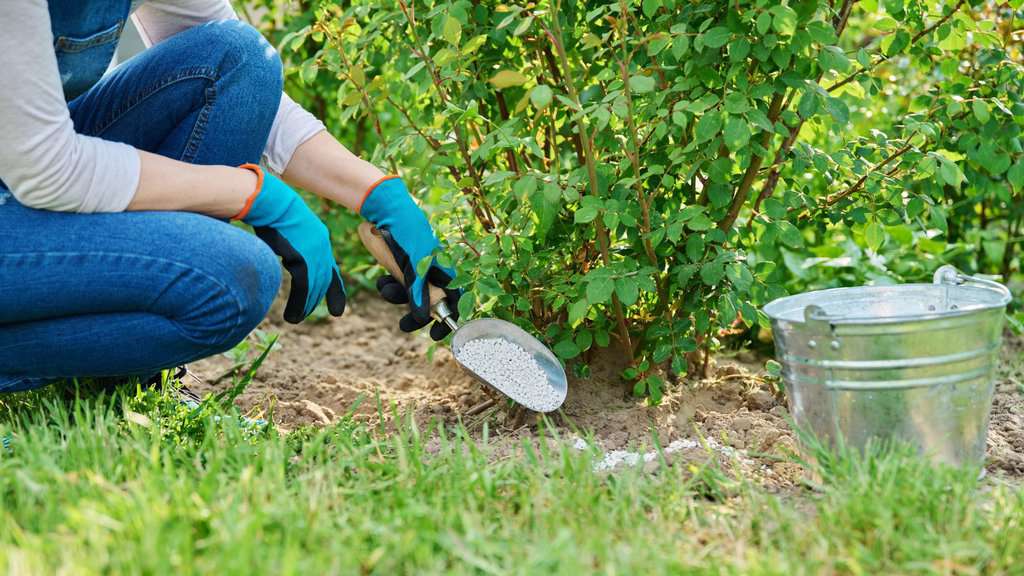
You can spread granular fertilizer by hand around the shrubs or use a high-capacity fertilizer spreader for large areas.
It’s best applied to mulched areas and shrub borders.
Fertilizer Spikes
This product, shaped like a spike or rod, contains pre-measured fertilizer that slowly releases over time.
Insert them by digging a small hole around the circumference of the shrub’s canopy and inserting the spike.
However, be sure to follow the product’s instructions for increased effectiveness.
Foliar Fertilization
This process involves spraying liquid fertilizers on the leaves to fix minor nutrient deficiencies quickly.
Put the Right Amount of Fertilizer
The soil analysis results usually include what fertilizer grade to use and how many pounds to apply in an area. Follow that recommendation to fertilize your shrub according to its plant and soil condition.
Generally, you can put 1 to 2 pounds of nitrogen per 1,000 square feet of space annually.
Space the applications throughout the year. Ultimately, consult a professional if you’re unsure how much fertilizer to apply to your shrubs.
Add Fertilizer at the Right Timing and Frequency
Splitting the required amount of fertilizer or nitrogen throughout the year to avoid overfertilizing your shrubs.
This strategy is highly recommended for shrubs or woody plants in sandy soils, as this soil type tends to lose nutrients quickly. Giving small amounts of fertilizer at frequent intervals will help retain soil nutrients.
Also, consider the season that you’re fertilizing. Avoid fertilizing shrubs during summer, as the soil may not have enough soil moisture to absorb the fertilizer. The soil must be moist or adequately watered to take in nutrients effectively.
When Should You Hire a Professional?
Here are some instances when you may need to hire a professional or get fertilization services.
When You Can’t Do It on Your Own
If you have already tried several ways to save your shrubs but there’s no improvement, it may be time to ask an expert for help.
Although products like fertilizer spikes help you apply fertilizers easily, these may not reach the root system or give your plant the right amount of nutrients it needs.
A professional can provide the right treatment for your shrubs based on their soil test result and care for them regularly, ensuring that the treatment is helping your plants.
If you don’t have prior background or knowledge in fertilizing shrubs, it’s highly recommended to seek professional help for your plants.
Without the right tools and knowledge, you may do more harm than good and even waste time and money.
When You Need to Address Other Concerns
Shrubs can also have weeds or pests that stunt their growth. If you have more than one problem to address in your garden, a professional can create a tailored treatment to eliminate weeds or pests, fertilize your shrubs, and improve soil health.
Ultimately, working with a professional depends on your garden needs, time, budget, and preference. SunCo offers pest control solutions to make this process easy.
Manage Your Outdoor Space Effortlessly with SunCo
If you want a fertilization or plant treatment service for your garden or commercial landscape, feel free to consult SunCo, a Midwest-based lawn care provider.
SunCo offers lawn maintenance, fertilization, weed control, and sprinkler system management for residential and commercial properties.
Talk to SunCo’s team today and see how we can help you!