

If it’s getting warm but your grass looks like a brown wasteland, you might think it’s dead.
Don’t panic; brown grass doesn’t always mean a dead lawn.
Grass has a survival mechanism called dormancy, where it temporarily turns brown to save energy during extreme heat, drought, or cold.
But how do you tell if your grass is dead or dormant?
Read on to learn five ways to determine whether you’re working with dormant grass or grass that’s gone for good.
Key Takeaways
- Dormant grass is brown with flexible blades and resists being pulled up.
- Dead grass shows no growth, breaks easily, and pulls up with little effort.
- Water, scratch, and root tests help confirm if grass is dead or dormant.
- Pests, fungi, or heat stress can mimic or cause dead-looking grass.
How To Tell if Your Grass Is Dead or Dormant
If your grass has stopped growing, use the following tests to determine if it’s dead or dormant:
| Feature | Dead Grass | Dormant Grass |
|---|---|---|
| Color | The entire lawn looks grayish-brown | Green at the base |
| Texture | Brittle and dry blades that snap easily when touched | Blades bend easily and feel dry but flexible |
| Growth | Shows no change after a week or more of care | Bounces back when watered consistently |
| Root strength | Pulls up easily with little resistance | Resists and stays rooted when tugged |
| Patch pattern | Shows up in patches (when caused by disease, pests, or chemical damage) | Happens uniformly across your lawn |
1. Color Check
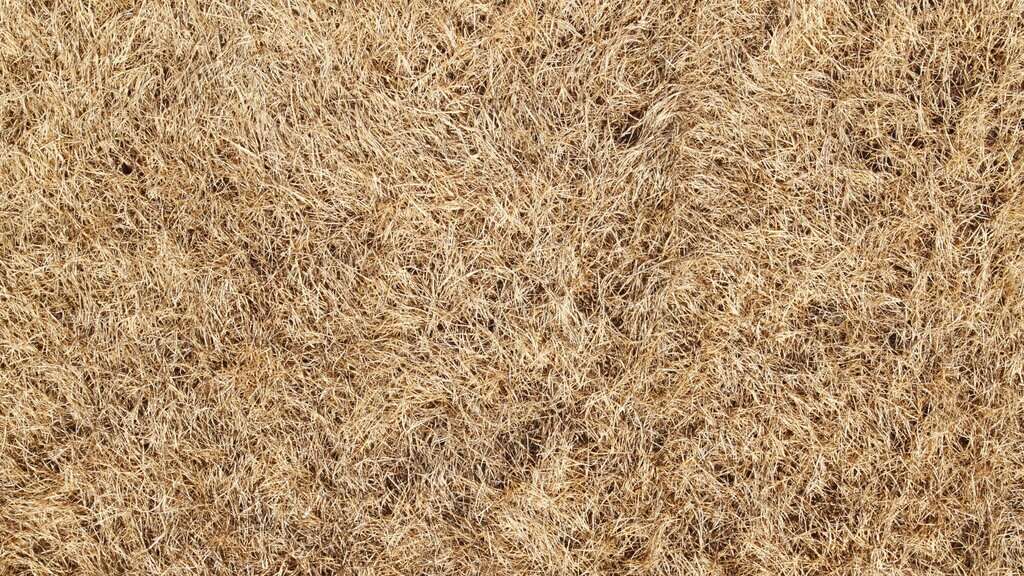
Dormant grass and dead grass both turn brown. But dormant grass usually has a hint of life near the base, while dead grass is brown or gray all the way through.
Here’s how to do a color check:
- Flatten your grass to see its crown, where it connects to the soil.
- Look for any sign of green at the base.
If you find green, even a faint tint, your grass is likely dormant and could recover with water and time.
But if everything is straw-brown or gray, you’re most likely dealing with dead grass.
2. Tug Test
If your lawn is brown and brittle, the tug test will help you check if your grass is still alive.
Here’s how to do it:
- Grab a small handful of grass blades.
- Gently tug upward without pulling them out.
- Notice how the grass reacts.
If the grass resists and stays rooted, it’s likely just dormant. But if it pulls out easily, it’s probably dead.
3. Water Test
Here’s how to do a water test:
- Pick a brown patch that you suspect is dormant.
- Water it deeply and thoroughly.
- Keep watering at least twice a week.
If you see green returning after a week or two of regular watering (and optional mulching), the grass was dormant.
But if the patch stays brown and dry, your grass is dead.
4. Scratch Test
When the top of your grass looks dead, the scratch test will help you understand what’s happening under the surface.
Here’s how to do it:
- Find the crown of the grass blade.
- Lightly scratch the surface of the base.
If you see green or white tissue under the outer layer, the grass is alive.
But if the crown is brown, dry, or hollow, the grass is dead and beyond saving.
Be sure to check several grass blades across different areas before making your final determination.
5. Root Check
To perform a root check:
- Dig out a plug of soil about 2–3 inches deep.
- Shake off the soil.
If the roots look white, cream, or light tan, your grass is likely dormant rather than dead.
But if they’re brown, black, shriveled, or missing entirely, your grass is dead.
3 Common Causes That Mimic Dead Grass
Let’s say your grass fails all the dead grass checks and only looks dead. Here’s why this may be happening:
1. Drought or Heat Stress
Grass needs constant moisture to stay green. When the soil dries out and temperatures climb, your grass will go dormant.
Most cool-season grasses like Kentucky bluegrass, perennial ryegrass, and tall fescue begin to suffer when temperatures reach 77–86°F (25–30°C).
When severe heat (especially temperatures over 95°F/35°C) combines with drought conditions for extended periods, it can shut down photosynthesis.
It also damages the grass’s internal structure and causes irreversible browning.
Here’s a quick look at the temperatures at which different types of grass begin to fail:
| Grass Type | Heat Stress Starts (°F) | Severe Damage (°F) |
|---|---|---|
| Kentucky bluegrass | 77°F | 90–95°F |
| Perennial ryegrass | 77–82°F | 90–95°F |
| Tall fescue | 85–90°F | 95–100°F |
| Bermuda grass | 95–100°F | 110°F |
| Zoysia grass | 90–95°F | 100°F+ |
Regional heat patterns also take a toll.
The Southwest (AZ, NM, NV) gets 100–110°F summers, which means if you have perennial ryegrass planted, it might be at risk of dying without consistent care.
2. Lawn Diseases and Fungi
Sometimes what appears to be dead grass is actually a lawn disease in progress.
Fungal infections are especially common in warm, humid conditions and can cause large brown patches, thinning, and even complete die-off if left untreated.
Fungus damage usually spreads irregularly, unlike drought stress, which tends to be more uniform.
Here are some of the most common lawn fungi and how to spot them:
| Disease | Appearance | Common Conditions | Grasses Affected |
|---|---|---|---|
| Brown patch | Large brown circles with dark edges | Warm, humid (75–85°F) | Tall fescue, ryegrass |
| Dollar spot | Small tan patches, bleached leaf tips | Cool nights, warm days, low nitrogen | Bentgrass, bluegrass, ryegrass |
| Rust | Orange powder on blades, slow growth | High humidity, shade, and nitrogen-deficient | Bluegrass, ryegrass |
| Summer patch | Irregular dead patches, root damage | Hot, moist, high-pH soils | Bluegrass, fine fescue |
| Fairy ring | Rings of dark green or dead grass | Warm weather, lots of thatch | All cool-season grasses |
Note that not everything patchy or discolored is a fungus.
Here are some non-fungal issues that may cause your grass to look dead:
| Condition | Appearance | What Causes It |
|---|---|---|
| Algae | Oily, greenish-black scum that hardens | Shade, poor drainage, compacted soil |
| Root-knot nematodes | Thin, patchy grass that won’t recover | Microscopic worms in soil |
| Slime molds | Orange, white, or purple slime on blades | Wet weather and leaf litter |
| Yellow spot (algae) | Yellow patches that spread slowly | Drought, low mowing |
While these issues won’t always kill your grass, they will interfere with its recovery, so you need to address the underlying problems promptly.
3. Pest Infestations
Some of the worst lawn damage may be caused by pests that attack your grass at its roots.
Here are some signs of a pest problem:
- Grass stems break off easily (billbugs)
- Damage appears in yellow to brown patches that spread fast (chinch bugs)
- Brown, spongy patches that lift easily (grubs)
- Scattered small brown patches (sod webworms)
- Bare spots chewed into the soil (armyworms)
What To Do Next
Once you’ve confirmed whether your grass is dead or dormant, here’s what to do:
Do a soil test
This will help you find any pH level issues, nutrient deficiencies, salt buildup, or other issues that caused your grass to die.
This will help you select the right fertilizer, create an optimal schedule to water your lawn on time, and prevent future damage to your lawn.
Wait and watch (maybe it’s seasonal)
Sometimes, the best thing to do is just wait.
If it’s the middle of a heatwave, deep winter, or a transitional season, you might just have a dormant lawn on your hands.
Just make sure to only do this after you’ve confirmed that your grass is alive.
Reseed or resod
If your tests confirm your grass is truly dead, you need to start over.
You should plant grass seed again if your lawn is patchy or damaged in a few places.
But if you find your lawn brown, you may need to resod the whole thing.
Learn How to Revive a Dead Lawn With SunCo Lawns
Drought, pests, poor soil, and harsh weather can take a toll on even the healthiest grass.
If your grass went brown and never came to life again, it’s likely time for a fresh start.
At SunCo Lawns, we help homeowners and companies understand why their lawn is looking dead, whether it could be saved, and how to revive dead grass if necessary.
Our team starts with a lawn assessment to learn what kind of lawn care and landscaping services you need.
Once we have a plan of action, we can reseed, resod, or revive your lawn.
Want to get your grass looking green again? Give us a call today!