

Key Takeaways
- Midwest lawns face common weeds like dandelions, crabgrass, and nutsedge.
- Weeds are classified as broadleaf, grassy, or sedge, each requiring unique control.
- Effective control includes proper identification, pre-emergent herbicides, and lawn maintenance.
- A comprehensive lawn care plan with balanced fertilization and aeration prevents weed growth.
Caring for a lush and healthy lawn isn’t always easy, particularly when weeds are involved.
These unwelcome intruders can quickly overtake your lawn, robbing your grass and plants of essential nutrients, water, and sunlight.
For homeowners and businesses in the Midwest, where varying climates and soil conditions create an ideal breeding ground for a variety of weed species, it’s important to know the type of weeds you’re up against.
Understanding the different types of weeds and how to effectively control them is crucial for maintaining a beautiful lawn.
In this article, we’ll explore the most common types of weeds found in Midwest lawns, their characteristics, and effective control strategies. We’ll also touch on the importance of a comprehensive lawn care program.
Categories of Weeds
Weeds can be categorized into three types: broadleaf weeds, grassy weeds, and sedges.
Each type has unique characteristics that affect how they spread and how best to control them:
- Broadleaf weeds: These weeds have wide, flat leaves and often flower. They are typically easy to spot due to their distinct appearance compared to grass.
- Grassy weeds: These weeds resemble grass, making them harder to distinguish from the desired turfgrass. They often blend in until they have spread significantly.
- Sedge weeds: Although they look similar to grassy weeds, sedges have triangular stems and prefer moist environments. They are particularly challenging to control because they can spread through seeds and underground rhizomes.
Common Broadleaf Weeds in Midwest Lawns
| Weed | Description | Control |
|---|---|---|
| Dandelion | Yellow flowers, deep taproots | Post-emergent in fall |
| White Clover | Small white/pink flowers | Spot treat with broadleaf herbicide |
| Creeping Charlie | Shade-tolerant, trailing stems | Post-emergent, improve lawn drainage |
| Chickweed | Dense mats, small white flowers | Pre- or post-emergent herbicide |
| Plantain | Broad or lance-shaped leaves | Aerate soil, apply broadleaf herbicide |
Dandelion
- Scientific Name: Taraxacum officinale
- Description: Dandelions are one of the most recognizable broadleaf weeds, known for their bright yellow flowers that turn into fluffy seed heads.
- Suitable Habitats: They thrive in sunny areas and are commonly found in lawns throughout the Midwest.
- Growing Period: Dandelions are perennial plants that can grow year-round, but they are most active in the spring and early fall when temperatures are cooler. They can flower and produce dandelion seeds multiple times throughout the growing season.
- How to get rid of it: Dandelions have deep taproots, making them tough to eradicate by hand pulling. To control them effectively, a post-emergent herbicide applied in the fall is often recommended.
White Clover
- Scientific Name: Trifolium repens
- Description: Clover is a common perennial broadleaf weed that features small, white, or pink flowers. It can also be presented with small yellow flowers.
- Suitable Habitats: White clover thrives in nitrogen-poor soils. While some homeowners tolerate clover due to its nitrogen-fixing abilities, it can quickly dominate a lawn if left unchecked.
- Growing Period: Clover is a perennial weed that grows throughout the year but is most active during the cooler spring and fall months. It can continue to spread during mild summer and winter conditions.
- How to get rid of it: Spot treatments with a broadleaf herbicide can help manage clover infestations.
Creeping Charlie
- Scientific Name: Glechoma hederacea
- Description: Also called ground ivy, it is a perennial weed known for spreading across lawns with its trailing creeping stems.
- Suitable Habitats: Ground ivy is shade-tolerant and often found in damp, shady areas of the lawn.
- Growing Period: Creeping Charlie is a common perennial weed that grows actively in the spring and fall.
- How to get rid of it: Control measures include using a post-emergent herbicide specifically designed for broadleaf weeds and improving lawn drainage and sunlight exposure.
Chickweed
- Scientific Name: Stellaria media
- Description: Chickweed is an annual weed that grows in dense mats and can quickly overtake lawn areas. It has small white flowers.
- Suitable Habitats: It prefers cool, moist conditions.
- Growing Period: Common chickweed is a winter annual that germinates in the fall, grows through the winter, and flowers in early spring. It typically dies off as temperatures rise in late spring and summer.
- How to get rid of it: A pre-emergent herbicide can prevent chickweed from germinating, while post-emergent treatments are effective for controlling existing plants.
Plantain
- Scientific Name: Plantago major and Plantago lanceolata
- Description: Plantain is a perennial broadleaf weed that grows low to the ground with broad, oval leaves or narrow, lance-shaped leaves.
- Suitable Habitats: They thrive in compacted soils and are often a sign of poor lawn health.
- Growing Period: Plantains are perennial weeds that grow actively from spring to fall. They are most commonly found during the warmer months but can persist into cooler weather, especially in compacted or stressed areas of the lawn.
- How to get rid of it: Aerating the lawn and applying a broadleaf herbicide can effectively control plantain weeds.
Common Grassy Weeds in Midwest Lawns
| Weed | Description | Growing Period | Control |
|---|---|---|---|
| Crabgrass | Low-growing, wide leaves, light green | Summer annual, germinates in late spring | Pre-emergent in early spring, post-emergent if established |
| Quackgrass | Tall, coarse blades, spreads by rhizomes | Cool-season perennial, spring/fall active | Systemic herbicide, difficult to remove mechanically |
| Foxtail | Clump-forming with bushy seed heads | Summer annual, germinates in late spring | Maintain dense lawn, post-emergent herbicide |
| Nimblewill | Wiry, mat-like patches, spreads by stolons | Warm-season perennial, active in summer | Non-selective herbicide, or lawn renovation |
| Annual Bluegrass | Light green, rapid seeder | Cool-season annual, fall/spring | Pre-emergent in fall/spring, regular aeration |
Crabgrass
- Scientific Name: Digitaria spp.
- Description: Crabgrass is a common grassy annual weed that grows low to the ground with wide, light green leaves.
- Suitable Habitats: Crabgrass thrives in hot, sunny conditions and can outcompete desirable grasses.
- Growing Period: Crabgrass is a summer annual weed that germinates in the late spring when soil temperatures reach about 55-60°F. It grows rapidly throughout the summer and dies with the first frost in the fall.
- How to get rid of it: A pre-emergent herbicide applied in early spring is the best defense against crabgrass, while post-emergent options are available for controlling established plants.
Quackgrass
- Scientific Name: Elymus repens
- Description: Quackgrass is a perennial grassy weed with coarse, bluish-green blades that can grow up to 3 feet tall.
- Suitable Habitats: It spreads through underground rhizomes, making it particularly difficult to pull weeds to eradicate.
- Growing Period: Quackgrass is a cool-season persistent perennial grass that grows actively in the spring and the fall. It can remain green and continue to grow during mild winter conditions, going dormant only during extreme cold or hot, dry summer conditions.
- How to get rid of it: Due to its aggressive nature, mechanical removal is often ineffective. A systemic herbicide is usually required to control quackgrass.
Foxtail
- Scientific Name: Setaria spp.
- Description: Foxtail weeds are clump-forming annual grasses easily recognized by their distinctive, bushy seed heads resembling a fox’s tail.
- Suitable Habitats: They are prevalent in areas with poor lawn density.
- Growing Period: Foxtail is a type of summer annual weed that germinates in late spring and early summer. It grows throughout the warm months and produces seed heads before dying with the first frost.
- How to get rid of it: Maintaining a thick, healthy lawn is the best preventive measure, while post-emergent herbicides can help manage established foxtail infestations.
Nimblewill
- Scientific Name: Muhlenbergia schreberi
- Description: Nimblewill is a perennial grassy weed that spreads through stolons and is often mistaken for desirable turfgrass. It grows in patches and has a wiry, mat-like appearance.
- Suitable Habitats: Nimblewill prefers shady, moist areas.
- Growing Period: Nimblewill is a warm-season perennial weed that grows actively during the summer months. It becomes dormant and turns brown in the cooler months of fall and winter.
- How to get rid of it: Nimblewill can be challenging to control without a non-selective herbicide or renovation of the lawn area.
Annual Bluegrass
- Scientific Name: Poa annua
- Description: Annual bluegrass is a light green, cool-season annual.
- Suitable Habitats: It thrives in compacted, moist soils. It produces seeds quickly and can create unsightly patches in a lawn.
- Growing Period: Annual bluegrass is a cool-season type of annual weed that germinates in the fall or early spring, grows through the cooler months, and sets seeds in the spring. It typically dies off in the heat of summer.
- How to get rid of it: A pre-emergent herbicide is effective in controlling its spread, while regular aeration can help improve lawn health and prevent annual bluegrass from taking hold.
Common Sedges in Midwest Lawns
| Weed | Description | Growing Period | Control |
|---|---|---|---|
| Yellow Nutsedge | Triangular stems, yellowish seed heads | Warm-season perennial | Sedge-specific herbicides |
| Purple Nutsedge | Dark green leaves, purple-tinged seed heads | Warm-season perennial | Targeted herbicides |
| Kyllinga | Dense mats, small round seed heads | Warm-season perennial | Improve drainage, sedge-specific herbicides |
Yellow Nutsedge
- Scientific Name: Cyperus esculentus
- Description: Yellow nutsedge is a perennial sedge with light green, triangular stems and yellowish seed heads.
- Suitable Habitats: It prefers wet, poorly drained areas and spreads through underground tubers called nutlets.
- Growing Period: Warm season perennial weeds.
- How to get rid of it: Control of yellow nutsedge often requires specific sedge herbicides, as it is resistant to many standard broadleaf and grassy weed treatments.
Purple Nutsedge
- Scientific Name: Cyperus rotundus
- Description: Similar to yellow nutsedge, purple nutsedge has dark green leaves and purple-tinged seed heads.
- Suitable Habitats: It is an aggressive perennial that spreads rapidly through rhizomes and tubers.
- Growing Period: A type of warm-season perennial weed.
- How to get rid of it: Like yellow nutsedge, it requires targeted herbicides for effective control.
Kyllinga
- Scientific Name: Kyllinga spp.
- Description: Kyllinga is a sedge that resembles nutsedge but forms dense mats and produces small, round seed heads.
- Suitable Habitats: It often invades lawns with poor drainage or excessive irrigation.
- Growing Period: A type of warm-season perennial weed.
- How to get rid of it: Effective control requires improving drainage and using sedge-specific herbicides.
Effective Weed Control Strategies
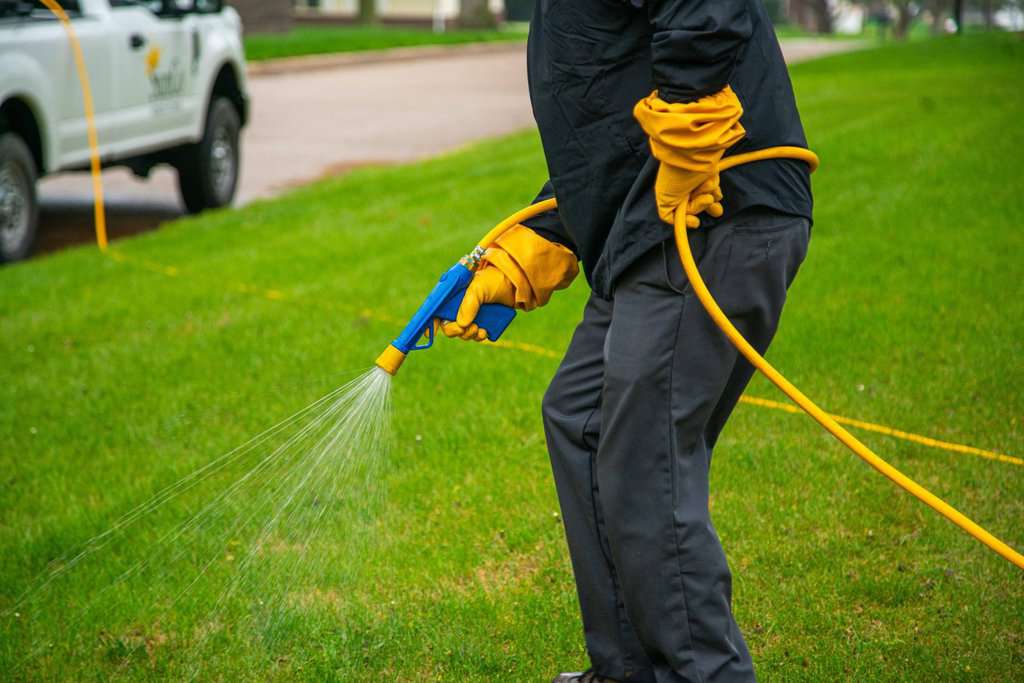
Understanding the types of noxious weed invading your lawn is the first step toward effective control.
Here are some key strategies to help you manage weeds in your Midwest lawn:
Regular lawn maintenance
Maintaining your landscape through regular mowing, watering, and fertilizing can help prevent weeds from taking hold.
A thick, carefully tended lawn can outcompete many weed species reducing the need for chemical controls.
Proper identification
Properly identifying weeds is crucial for choosing the right control method.
Some weeds may require specific herbicides, while others can be managed through cultural practices like improving soil conditions or adjusting mowing heights.
A pre-emergent herbicide
A pre-emergent herbicide works by preventing weed seeds from germinating.
It is most effective when applied in early spring before weeds like crabgrass and chickweed begin to sprout.
Post-emergent herbicides
Post-emergent herbicides target weeds that have already emerged and are actively growing.
They can be selective; targeting specific weed types, or non-selective; affecting any plant they contact.
Proper application is key to minimizing damage to desirable turf.
Lawn aeration
Aeration (both natural aeration as well as mechanical aeration) helps relieve the compacted soil, making it easier for water, nutrients, and air to penetrate the grassroots.
This process strengthens the lawn and increases resilience against weed infestations.
Proper fertilization
Balanced fertilization is essential for maintaining lawn health.
Too much or too little nitrogen can encourage weed growth, so it’s important to follow a fertilization schedule that meets the needs of your specific grass type.
Irrigation management
Over-watering or poor drainage can create ideal conditions for weeds like sedges and annual bluegrass.
Proper sprinkler system management ensures that your lawn gets the right amount of water without creating wet spots where weeds can thrive.
Why a Well-Rounded Lawn Care Plan Matters
Invasive weed control is just one aspect of maintaining a healthy lawn.
A comprehensive lawn care program that includes regular maintenance, proper fertilization, and effective irrigation management is key to preventing garden weed infestations and promoting a green lawn.
By addressing all aspects of lawn health, you can create an environment where weeds are less likely to thrive.
Contact SunCo for Expert Lawn Care Services
If you’re struggling with stubborn weeds or aiming to maintain a beautiful lawn throughout the year, our team is here to help.
We’ve got you covered with our comprehensive lawn care services that include weed control, regular maintenance, fertilization, and sprinkler system management—all specifically designed for Midwest lawns.
Reach out to us today to get a quote, get answers to your questions, or discover how we can help you achieve the vibrant green lawn of your dreams.
Call us at (402) 972-8603 or visit our website to schedule a consultation with our lawn care experts.