![Grass Weeds Explanation [+ Identification Pictures] In 2025](https://suncolawns.com/wp-content/uploads/2025/06/grass_weeds_identification_pictures_1.jpg)


Weeds in grass are the eternal nemesis of every lawncare enthusiast. They compete with your plants for space, nutrients, and sunlight, growing where they’re not supposed to.
Our guide will provide fundamental knowledge of grass weeds and practical resources to help you identify the various species, keeping your lawn weed-free.
Key Takeaways
- Identify weed species early to apply proper control and elimination methods.
- Weed types vary by lifecycle: annuals, perennials, and sedges each need strategies.
- Broadleaf and grassy weeds differ in appearance, growth, and control tactics.
- Healthy, dense lawns with good care can naturally prevent many common weeds.
- 14 Weed Types and What They Look Like
- 1. Poison Sumac (Toxicodendron vernix)
- 2. Japanese Knotweed (Polygonum cuspidatum)
- 3. Crabgrass (Digitaria)
- 4. Creeping Charlie (Glechoma hederacea)
- 5. Cudweed (Gnaphalium spp.)
- 6. Dayflower (Commelina spp.)
- 7. Fleabane (Erigeron spp.)
- 8. Dandelion (Taraxacum ofiinale)
- 9. Shepherd’s Purse (Capsella bursa-pastoris)
- 10. Quackgrass (Elytrigia repens)
- 11. Chickweed (Stellaria media)
- 12. Common Ragweed (Ambrosia artemisiifolia)
- 13. Clover Leaf (Trifolium repens/pratense)
- 14. Horsetail Weed (Equisetum arvense)
- How to Differentiate the Common Grass Weeds for Better Weed Identification
- Frequently Asked Questions
14 Weed Types and What They Look Like
Knowing what each weed looks like can help you quickly apply the right control and elimination solution.
Not all weeds are nuisances, though. Some weeds can serve as useful groundcover, retaining nutrients in the soil while also providing an ornamental benefit.
Here are 20 of the most common weed types and how to identify them.
1. Poison Sumac (Toxicodendron vernix)
One of the most common weed shrubs is poison sumac, which is typically found in wetlands and swamps in the Eastern United States, often near cattails and cinnamon ferns.

In the summer, poison sumac is bright green. In fall, its foliage turns dark red or orange.
These plants have toothed leaf edges, brown stems, and thrive in drier, open areas.
2. Japanese Knotweed (Polygonum cuspidatum)
Also known as fleece flower and American bamboo. It has shovel-shaped leaves and a fleecy look, which disguises its extreme hardiness.
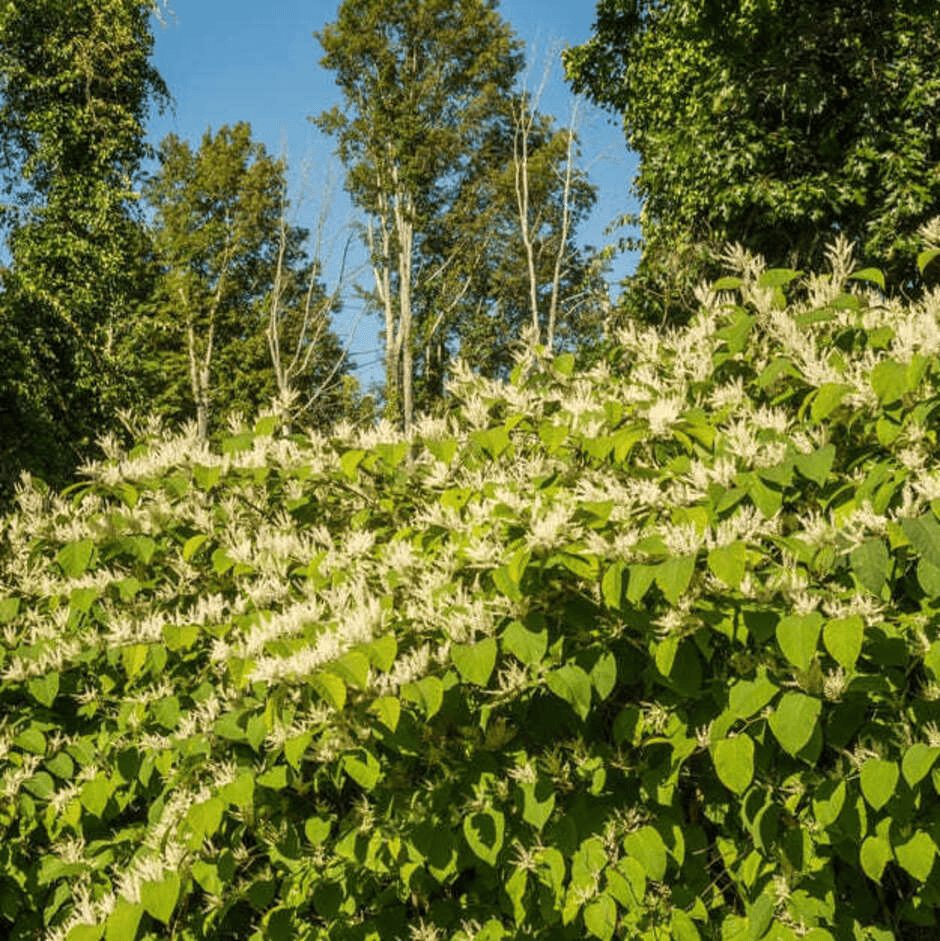
At maturity, it produces canes up to six feet tall, meaning that it can quickly infest your yard if left unchecked.
Although it dies in the winter, this weed leaves behind brown, tall canes, which are unsightly in your landscape. It can also be found in areas like roadsides and riverbanks.
3. Crabgrass (Digitaria)
A grassy annual, crabgrass can grow up to 18 inches tall in various parts of your lawn, landscape, garden, or any shady area.
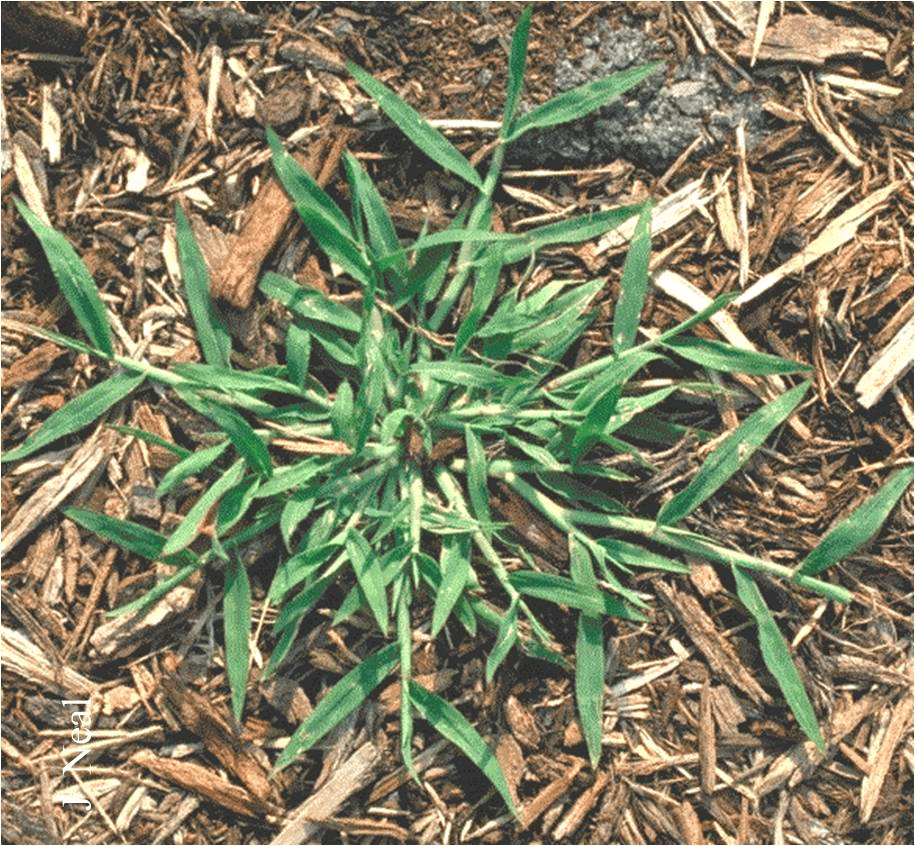
As a weed that blooms in the spring, it’s important to combat its often rampant seed spread through the use of pre-emergents.
In lawns, you can use selective herbicides. In places like sidewalks or wall cracks where nothing else grows, non-selective herbicides are most effective.
4. Creeping Charlie (Glechoma hederacea)
Also known as ground ivy, this broadleaf perennial grows up to four inches tall, spreads aggressively through its stolons and persists in shady lawns and woodland edges.
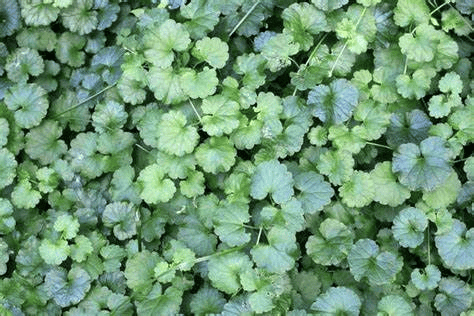
This is a very invasive creeping lawn weed and can be very difficult to get rid of once it appears in your yard.
You can identify creeping Charlie by its kidney-shaped leaves and the minty scent it emits when crushed.
This weed has waxy leaves, which grant it resistance to several herbicides, so the best way to fight its spread is through spring mulching and post-emergent use.
5. Cudweed (Gnaphalium spp.)
Also referred to as Old Field Balsam or Rabbit tobacco, cudweed forms a loosely branched rosette in winter. By spring, the upright stem bears grey-green leaves with woolly hairs, giving it a fuzzy texture.

Cudweed thrives in sandy and dry soils. To prevent cudweed from infesting your lawn, grow your turf thick using the best lawn care practices.
We suggest aerating and overseeding in the fall in order to keep your lawn growing ever-increasingly thicker.
6. Dayflower (Commelina spp.)
Widow’s tears, also known as dayflower, is an annual grass relative that grows up to 30 inches tall and wide in shady landscape areas.
They typically have dark green leaves three to five inches long, with smooth, succulent stems.
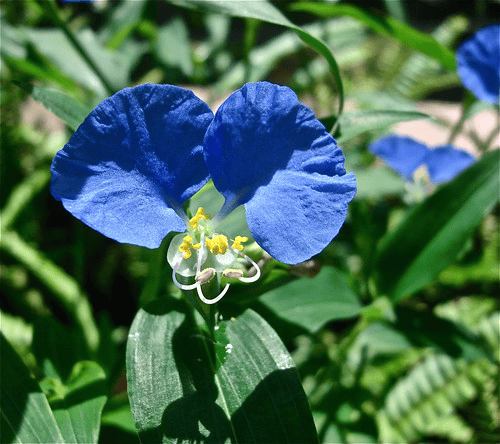
Their seeds are held within small brown capsules that burst when ripe. As the name suggests, each flower blooms for only a single day.
Some of the most common species of dayflower are
- Asiatic Dayflower (Commelina communis): Is the most widespread and invasive
- Virginia Dayflower (Commelina virginica): Is the least aggressive species.
- Benghal Dayflower (Commelina benghalensis): Has purple flowers with hairy leaves
To control the spread of dayflower, mulch your garden and use pre-emergent herbicide in the spring. You can also manually pull out the weeds by their root and stems,
7. Fleabane (Erigeron spp.)
Fleabane is a broadleaf annual that can be identified through its upright stem holding slender leaves that are often toothed or hairy.
They can also grow up to three inches tall. Their stems are often covered in fine hairs, producing small lavender-white flowers that resemble daisies.

Fleabane blooms from late spring to fall, with multiple flowers growing from each stem.
Common species of this broadleaf weed include:
- Annual Fleabane (Erigeron annuus) – Grows taller with more branches
- Philadelphia Fleabane (Erigeron philadelphicus) – Pinkish flowers, prefers moist soil.
- Alpine Fleabane (Erigeron alpinus) – Low-growing, found in rocky areas.
8. Dandelion (Taraxacum ofiinale)
Despite whatever fond memories dandelions inspire in you, they’re perennial weeds that develop firm and deep tap roots, which can be hard to pull out by hand.

Also known as lion’s tooth, its leaves are dark green, hairless, and bleed a milky sap when broken or crushed.
Its flowers are bright yellow and turn into a fluffy white seed head, the reason why it’s also known as blowball.
Dandelions grow in thin, sparse lawns. By regularly overseeding and mulching, the lawn’s dense growth will keep their numbers low.
9. Shepherd’s Purse (Capsella bursa-pastoris)
Shepherd’s purse is a weed with rosette, deeply toothed, arrow-shaped stem leaves, and tall stems that can grow as high as 50cm.
Its flowers are four-petaled, with seed pods that turn green to brown as they mature, rattling when dry.

To keep their numbers low, remove young plants by hand early in the growing season, and continue to monitor your lawn for any regrowth.
Pre-emergent herbicides are effective at keeping this cool-season weed’s seeds from germinating.
10. Quackgrass (Elytrigia repens)
Quackgrass is distinguished by its long, leafy blades with rough surfaces. The plant produces wheat-like seed heads at maturity.

Like dandelions, quackgrass develops firm, deep roots that easily regrow if not completely pulled out of the soil.
By adopting core lawn care practices, such as regular mowing, you can prevent the formation of quackgrass seeds.
Overseeding areas where the turf grass is thinner provides overwhelming competition for quackgrass, while keeping the lawn dense.
11. Chickweed (Stellaria media)
Chickweed is a winter annual weed characterized by its very small, fuzzy leaves.
Also known as starweed, chickweed blooms with small white flowers in the spring and thrives in moist, shady areas.

From its shallow, fibrous roots, it produces hundreds of seeds that can quickly infest a lawn if unchecked.
Pulling out chickweed by hand is easy, but its aggressive spread and capacity to host viruses mean that chemical control is the most effective way to manage its growth.
Apply pre-emergents in the late fall or early winter for better effectiveness.
12. Common Ragweed (Ambrosia artemisiifolia)
Ragweed is more than just a pesky weed. Its pollen is responsible for fall and summer season allergies.
They resemble ferns, but they develop greenish blooms with inconspicuous yellow-green spikes at the top of their stems.

Its leaves are deeply lobed, hairy, and usually of a deep green color. Using broadleaf herbicides containing 2,4-D amine weed killer is the quickest way to get rid of ragweed in your lawn.
13. Clover Leaf (Trifolium repens/pratense)
Cloverleaf flowers may be red, white, or pink, globe-shaped clusters, and bloom from spring through fall.
The clover leaf features a distinct V-shaped or white crescent mark, accompanied by three oval leaflets.
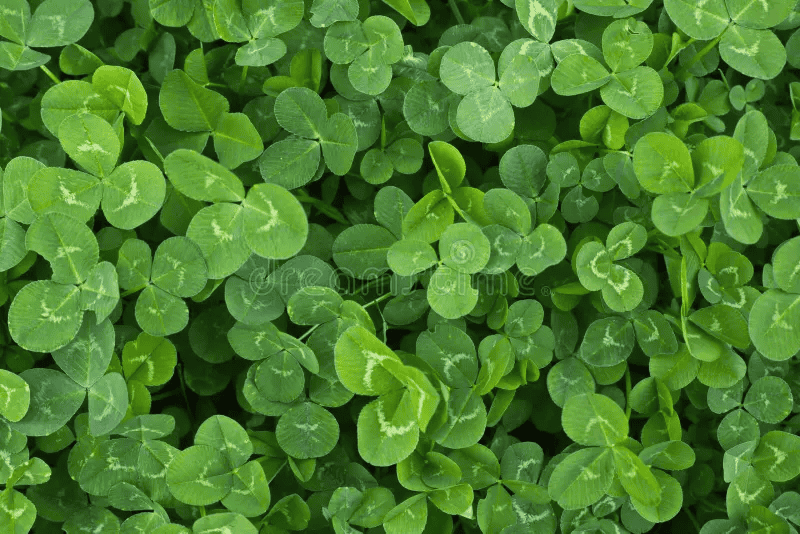
Unlike other weeds, clover, when well-managed, can thrive in your lawn for ornamental purposes.
They’re also great for soil fertility, as they help fix nitrogen into the soil and attract pollinating bees and butterflies.
14. Horsetail Weed (Equisetum arvense)
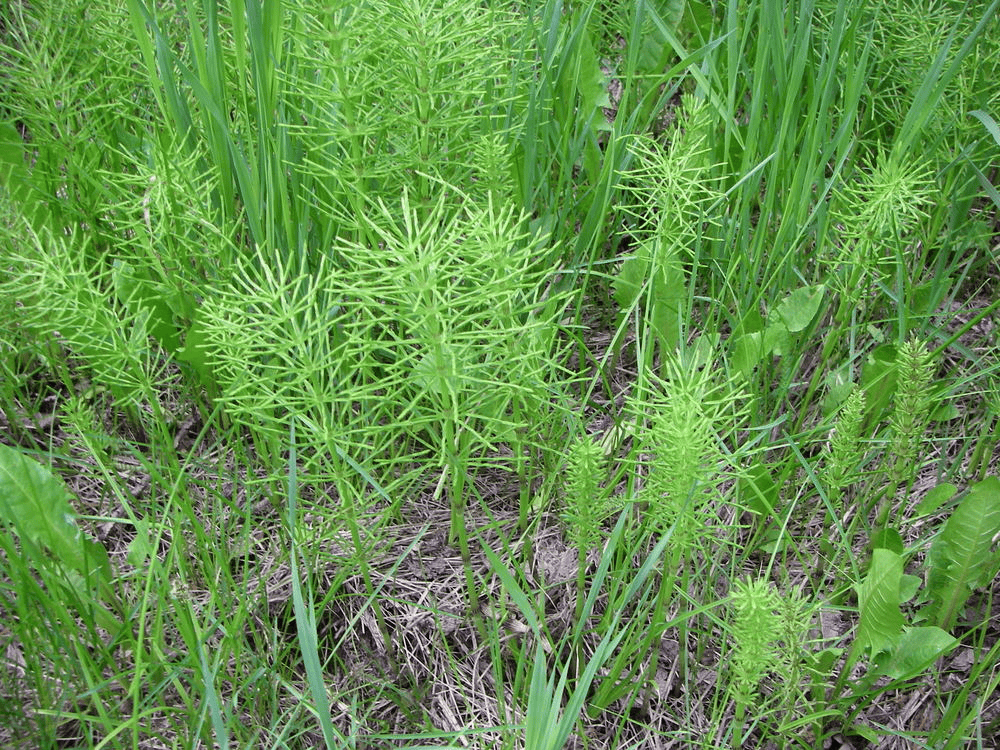
Horsetail weed is a hardy plant that grows wildly even in dry soil conditions.
With its erect single stem reaching up to six feet in height, horsetail thrives in disturbed areas, lawns, and sidewalks.
It reproduces via spores, not seeds, and has distinctive cone-like structures called strobili
How to Differentiate the Common Grass Weeds for Better Weed Identification
All grass weeds can be categorized based on factors like the life cycle, plant type, and toxic state:
Broadleaf Winter Annuals
These refer to weeds whose seeds germinate from late summer into fall and continue to grow even in early spring.
Examples are:
- Chickweed
- Hairy bittercress
- Deadnettle
- Henbit
- Knawel
Grassy Winter Annuals
These are grass weeds whose seeds germinate in late summer to early September.
- Annual bluegrass
- Little barley
- Downy brome
- Wild oats
Broadleaf Summer Annuals
You can expect weed seeds to start germinating as the winter recedes and the soil becomes warmer. The seeds continue to germinate throughout the growing season.
As the name implies, broadleaf annuals complete their life cycle in a single growing season.
- Black medic
- Carpetweed
- Mallow
- Prostrate Spurge
- Purslane
Broadleaf Perennials
Perennials are weeds that persist year to year, constantly reproducing. While they’re easier to eliminate, they can be tricky to manage.
They include:
- Broadleaf plantain
- Buttercup
- Common cinquefoil
- Dandelion
- Ground ivy
- Wood sorrel
Grassy Perennials
Grassy perennials persist yearly, growing and reproducing through their roots, stolons, and rhizomes, making them difficult to eliminate.
They include:
- Bermudagrass
- Dallisgrass
- Nimblewill
- Orchardgrass
- Roughstalk bluegrass
Sedges
Often mistaken for true grasses, they are distinct for their triangular stems. They also thrive in moist conditions.
Sedges have fibrous roots with small, nut-like tubers, known as nutsedge. Examples include:
- Green kyllinga
- Yellow nutsedge
- Globe sedge
Frequently Asked Questions
How can I tell the difference between grassy weeds and broadleaf weeds?
The main difference between grassy weeds and broadleaves is that the latter have wider leaves with net-like vein patterns. Examples include clover and dandelion.
Grassy weeds have thinner leaves and parallel veins, e., quackgrass and crabgrass.
Why do weeds keep growing in my yard?
Weeds grow where your lawn is weak or conditions favor them. Poor lawn density, with bare spots, provides weeds with space to grow.
Watering problems, such as overwatering or underwatering, can encourage various weed types.
Compacted soil and mowing grass too short also create ideal conditions for weeds to thrive, which can stress your lawn.
What are some natural ways to control weeds without herbicides?
In smaller lawns, you can pull weeds out by hand. However, it can be challenging to remove the entire root system when dealing with stubborn weeds.
In pavement cracks, you can kill weeds by pouring boiling water on them. A vinegar solution mixed with dish soap can eliminate young weeds.
When is the best time to treat weeds for the best results?
The timing depends on the treatment method. To prevent grassy weeds like crabgrass, apply pre-emergent herbicides in early spring when soil temperatures reach approximately 55°f.
Avoid applying herbicides during very hot weather (above 85°F) or drought conditions.