
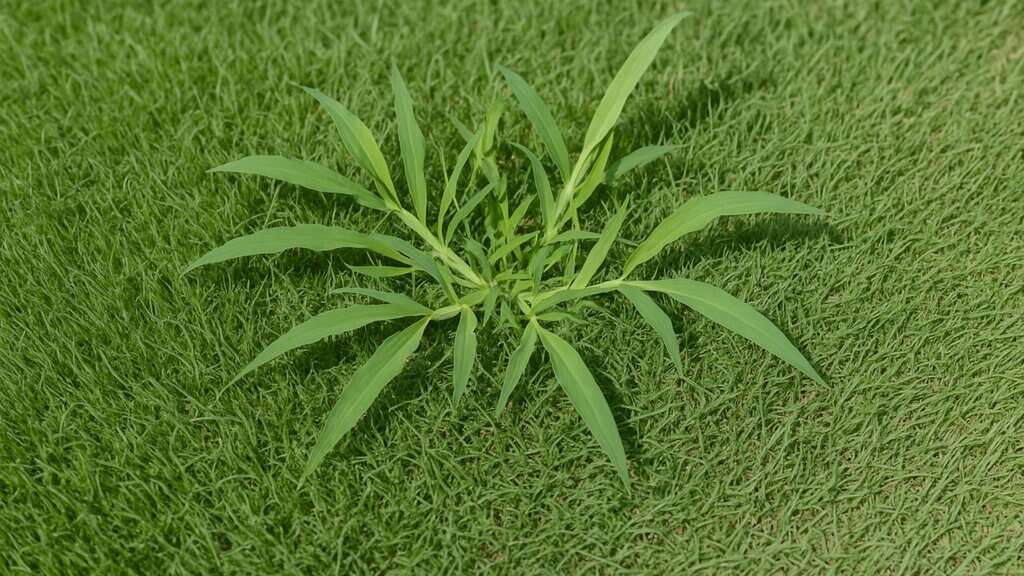
Crabgrass is an annual warm-season grass that’s considered one of North America’s most troublesome lawn weeds. Scientifically Digitaria species, landscapers primarily deal with D. sanguinalis, or hairy crabgrass, and D. ischaemum, or smooth crabgrass.
Though its resilience and adaptability in wild settings led to it playing a historical role as a grain crop in Eastern Europe, these same characteristics cause crabgrass plants to prevent you from maintaining a uniform lawn with healthy grass.
Learn them to control it effectively below.
Key Takeaways
- Crabgrass is an aggressive annual weed that invades weak or stressed lawns.
- It thrives in compacted soil and hot, dry conditions with little competition.
- Prevent crabgrass with proper mowing, aeration, and pre-emergent herbicide use.
- Manual removal or post-emergent herbicides help control established crabgrass patches.
Crabgrass: Characteristics
Here’s how you can identify crabgrass:
- It has coarse-textured leaves with a light green to yellow-green color.
- Crabgrass seeds grow low with stems that radiate outwards like crab legs, hence the name.
- It spreads through prolific seed production; a single plant can produce thousands of seeds that remain viable in the soil for years.
- It outcompetes desirable grasses in stressed and thin laws.
- Seed germination begins when soil temperatures range from 55°F to 60°F for several consecutive days, usually 3 to 5.
- It establishes an extensive, fibrous root system that can extend well below ground.
- It’s very tolerant to heat and drought but dies with first frost and leaves bare patches in lawns.
- It thrives in compacted, nutrient-poor soil and can adapt to various conditions and pH levels.
Crabgrass: Prevention
Crabgrass isn’t a grass you’d want to proliferate on your lawn. Due to its growth habits, the best control strategy is prevention. You’ll most likely never have to deal with it if you stick to the following lawn care practices.
- Maintain desirable grasses at a height that can shade the soil and prevent it from germinating. A height of 2.5–3 inches is perfect.
- Aerate at least annually, as crabgrass thrives in compacted soils, whereas desirable lawn grasses typically don’t.
- Apply a pre-emergent herbicide in early spring before soil temperatures reach 55°F.
- Water deeply but infrequently to allow your desirable grasses to grow deep roots.
- Overseed thin areas, particularly during the summer, to prevent crabgrass from snatching them.
- Don’t scalp your lawn (remove more than ⅓ of the grass blades), as it de-shades your turf and creates the perfect conditions for crabgrass.
Remember to be very careful when handling herbicides! Read the labels and follow usage instructions!
Crabgrass: Control
Crabgrass spreads ferociously and becomes a pesky challenge to overcome if you neglect caring for your lawn. If it does, you can try the following:
- Manually remove the crabgrass long before they begin germinating. It’s easier to do so when the soil is moist.
- Use a selective post-emergent herbicide, such as Quinclorac 75 DF. Apply it to actively growing weeds.
If you’re unable to reach effective, long-term results, let us step in. Our experts at SunCo Lawns can develop a comprehensive management plan tailored to your lawn’s specific needs. Get rid of crabgrass today; contact us!
Check Out These Terms!
- Bermuda Grass: Learn how Bermuda grass can be a gorgeous turfgrass or a pesky weed here.
- Clovergrass: Discover white clover and its nitrogen-fixing ability. Transform your lawn into an attractive space.
- Indian Grass: Learn why Indian grass is the perfect option for creating a prairie-like garden.