

Key Takeaways
- Dandelions are weeds that spread rapidly via seeds and deep roots.
- They outcompete plants for resources, overtaking lawns and landscaped areas quickly.
- Removal methods include manual pulling, boiling water, herbicides, and mulch prevention.
- Aeration and fertilization improve soil health to naturally resist weed growth.
Are dandelions friend or foe?
That’s the question many homeowners and commercial property owners have when they spot the yellow-headed flowers and dandelion leaves sprout up on their landscaping.
Dandelions have a certain nostalgic appeal, and blowing on them once they turn white and fluffy is a childhood pastime.
Yet at the end of the day, dandelions do indeed count as weeds. SunCo elaborates on the dangers of dandelions and how to get rid of them.
What Are Dandelions? Are They Weeds?
Dandelions are flowering plants from the Taraxacum genus and Asteraceae family, with two main species: Taraxacum erythrospernum (red-seeded dandelion) and Taraxacum officinale (common dandelion).
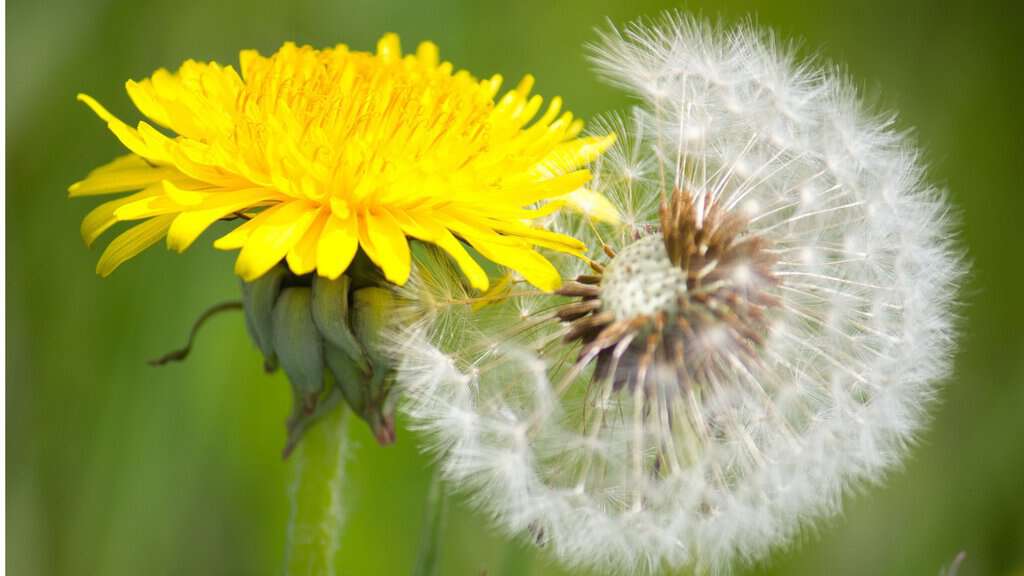
Recognizable by their bright yellow flowers, dandelions bloom in early spring – especially in the Midwest. These flowers consist of tiny florets, which eventually mature into white, fluffy seed heads by early fall.
These seed heads are easily carried by the wind—or even by blowing—resulting in the rapid spread of new dandelions.
Despite their visual appeal and childhood nostalgia, dandelions are classified as weeds. Their seeds spread aggressively, and they can overtake lawns, gardens, and landscaped areas, often at the expense of other plants.
Their deep taproots make them hard to remove and capable of regenerating even if partially removed.
While considered weeds, dandelions also have beneficial uses. The greens are edible and can be used in salads, teas, or even dandelion wine.
Additionally, dandelion leaves and roots are used in herbal medicine for their digestive, diuretic, and appetite-stimulating properties.
However, their rapid growth and invasive nature firmly establish them as weeds when it comes to landscaping and lawn care.
What Are the Risks of Dandelions?
While the bright yellow flowers of dandelions might look pretty, especially before they reach maturity, this medicinal plant can cause trouble in a commercial or residential landscaped area before you know it.
Here are some of the risks:
Hard to Remove
A dandelion root tends to go deep into the earth. Picking the flowers isn’t enough to eradicate the weeds. You have to get all the way down to that deep taproot level, and doing so by hand is more work than most people realize.
We usually only recommend hand removal for weeds in certain scenarios, and contending with dandelions is not one of them. They usually spread too far and deep for manual pulling to be a workable solution.
Here’s another interesting but frustrating fact about dandelions: they can regenerate at a root level. Yes, seriously.
So, if you cut the roots or leafless stalks into large pieces, such as to make a compost pile, more dandelions can sprout from that root, worsening your problem.
Far-Reaching Spread
It only takes a gust, whether by mouth or the wind, to transfer the fluffy white dandelion seed heads when they reach maturity. And the seed heads are capable of tremendous travel rates, up to 500 meters.
That means dandelions can spread throughout a landscaped yard very quickly and often without your intervention.
Prevent Resources to Other Plants
When weeds take over, they stop grasses, flowers, and plants from growing as bountifully.
They just don’t have the resources, be it sunlight, nutrients, or water. These plants end up competing for the space, too, as weeds will have taken over.
The high rate of dandelion spread means it won’t take long before your lawn is covered entirely in yellow.
How to Remove Dandelions From Your Property
The following removal options run the gamut from natural remedies to chemical treatments that kill dandelions.
The experts at SunCo are always available to help you select the best option for your commercial or residential property, so contact us if you have any questions.
Manual Removal
Yes, we just talked about how difficult it is to manually remove dandelion weeds.
However, you’ll also recall that we still recommend this removal method if you only have a smattering of yellow-flowered weeds on your property.
Put on your best gardening gloves, and invest in or borrow a hand rake or dandelion puller if you don’t already have one.
How do you use a dandelion puller for maximum efficiency? Match the tine tips with the dandelion above the surface. Next, push down with your foot, and the tines will enter the soil.
Once you see the dandelion puller’s knob ascend, that’s your cue to pull up. However, take your time to ensure you can rip out the entire dandelion, tap root and all.
Boiling Water
This next method is less glamorous but still gets the job done.
Pouring boiling water on dandelions will kill them on the spot. All you need to do is fill a pot of water, boil it, and then dump it on the offending weeds.
However, we have a couple of words of caution here. First, this method works best on younger versus more mature dandelions, as they may have more advanced root systems that are harder to kill with hot water alone.
Another caveat is this. You have to be very strategic about where you pour boiling water. If the water reaches your other healthy plants and flowers, they can be negatively impacted and possibly even killed.
Lastly, you must work extremely slowly and meticulously when using boiling water to avoid burning yourself.
Herbicide
Chemicals are one of the most efficient ways of treating dandelions and other weeds, including invasive species.
Herbicide has different formulas that can destroy weeds on a cellular or hormonal level, preventing cellular growth or inhibiting photosynthesis.
Which herbicide you choose depends on how much you know about your dandelion weeds. If you have a good idea of which species it is and what its growing habits are, you should use a pre-emergent herbicide.
These products are most effective on weeds before they emerge. You never have to worry about seeing yellow flowers or floaty white dandelion heads on your property.
Post-emergent herbicides are for weed problems with fewer symptoms. You don’t need to know which dandelion species you’re dealing with or when it appears on your lawn, as post-emergent herbicide kills emergent weeds.
Mulch
As we always warn, mulch isn’t a weed treatment in and of itself. Rather, it’s designed to prevent weeds and augment your weed-free measures.
Mulch blocks sunlight and provides less space for weeds to grow, which means fewer yellow flower heads popping up here, there, and everywhere.
Best of all, you can create mulch using DIY materials that would usually go in your compost scrap heap. That’s especially efficient if you’re on a tight budget.
SunCo also has mulch options for professional-looking landscaping that will make a sterling impression.
Aeration
You should also consider aerating and overseeding your lawn.
This is another preventative measure that keeps your plants and flowers healthy, happy, and thriving.
Aeration improves soil texture, making it lighter and fluffier so air and nutrients can travel better than in compacted soil.
Depending on the time of year, you might want to follow up the aeration with an application of fertilizer.
Feeding your plants the nutrients they need to thrive will make them more weed-resistant, as they can fight off invasive species like dandelions.
Got Dandelions? Let SunCo Help
Dandelions are a common flower, but despite their lovely appearance, they are still weeds.
As they mature, the yellow flowers disappear, replaced by white, fluffy seed heads that can travel with the breeze (or an inquisitive person blowing on them). Those seed heads land and cause more dandelions to grow.
SunCo is the top choice for your landscaping needs if your dandelion problem has gotten out of hand. Explore what we can do for you, and get in touch with us now.